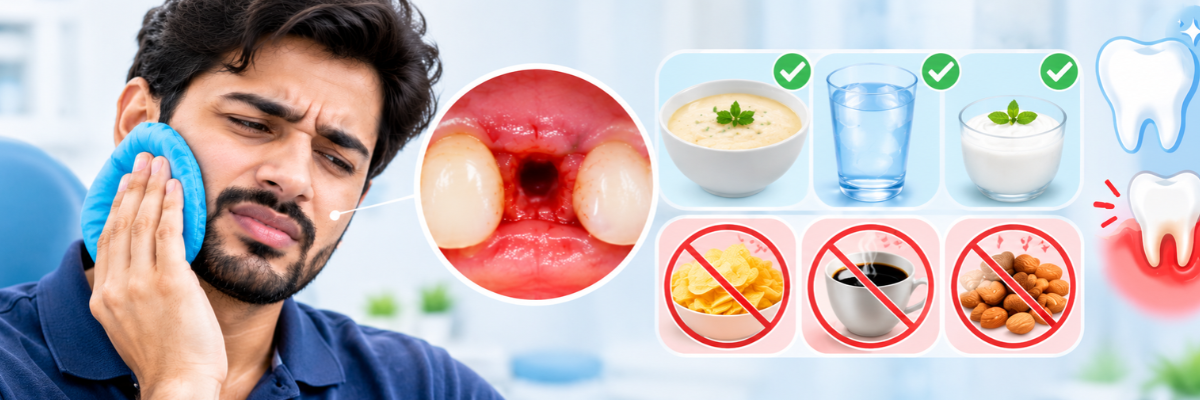
In short: For the first day after a tooth extraction, stick to cool or lukewarm soft foods such as curd rice, yoghurt, mashed banana, khichdi or lukewarm soup. Avoid hot, spicy, crunchy or sticky foods, straws and smoking, which can dislodge the blood clot. Move to firmer foods as comfort allows over the following days. Your own dentist's instructions come first.
You've had a tooth taken out, the numbness is wearing off, and the big question is: what can I actually eat? Good news, a lot of everyday Indian comfort food is exactly what a healing mouth wants. Here's a simple day-by-day guide to what to eat after a tooth extraction, what to skip, and how to deal with bleeding and swelling.
Heads up: every mouth and every extraction is different. If your dentist or surgeon gave you written instructions, follow those first. Use this guide as a friendly extra.
Why does food matter after an extraction?
After the tooth comes out, a blood clot forms in the socket. That clot is your body's natural bandage. It protects the bone and nerves underneath and gives the gum a base to heal on. Hot food, hard bits, sucking through a straw or rinsing hard can knock the clot loose, which slows healing and can lead to a painful problem called dry socket. Choosing the right food is mostly about protecting that clot.
What can I eat in the first 24 hours?
Wait until the numbness has worn off, so you don't bite your cheek or tongue. Then choose foods that are soft, cool or lukewarm, and need very little chewing:
Curd rice or plain curd
Plain yoghurt or lassi (sip from a spoon or a cup, not a straw)
Mashed banana or a soft ripe fruit pulp
Khichdi, cooled to lukewarm
Lukewarm dal water or a thin, mild dal
Lukewarm soup with no chunks
Mashed potato
Scrambled egg or soft omelette
Soft ice cream or kulfi in small amounts, if cold feels good
Smoothies eaten with a spoon
What should I avoid after a tooth extraction?
What can I eat from day 2 onwards?
As the area settles, you can slowly add more texture:
Days 2 to 3: soft idli, upma, soft chapati dipped in dal, well-cooked rice with curd, scrambled paneer, soft vegetables, boiled egg. Chew on the opposite side.
Days 4 to 7: most normal soft-to-medium foods as comfort allows. Keep avoiding crunchy, sticky and very hard food near the site.
After about a week, many people are back to regular meals. If the extraction was surgical, like an impacted wisdom tooth, healing may take longer, and your surgeon will guide you.
How do I manage bleeding after a tooth extraction?
A little oozing or pinkish saliva is normal for the first day. To manage it:
Bite firmly on a clean gauze pad placed over the socket for around 30 minutes, without checking it every minute.
If it's still bleeding, replace with a fresh pad and bite again. A moistened tea bag (kept cool) is sometimes used the same way.
Keep your head raised and rest. Avoid exercise and bending over for the day.
Don't spit repeatedly or poke the area with your tongue or fingers.
If bleeding is heavy, bright red and doesn't ease after steady pressure, contact your dentist or surgeon.
How do I reduce swelling?
Some swelling is part of normal healing, and it often peaks around the second or third day before settling. For the first day or two, hold a cold pack wrapped in a cloth against the cheek in short spells. Sleep with your head slightly raised. If swelling keeps increasing after the third day, or comes with fever or a bad taste, let your dentist know.
When can I brush and rinse?
Brush your other teeth as usual from the evening, taking care around the extraction site. From the next day, rinse gently with lukewarm salt water after meals and let the water fall out of your mouth rather than spitting hard. Do this for several days to keep the area clean.
What is dry socket?
Dry socket happens when the blood clot is lost or doesn't form, leaving bone and nerve endings exposed. The classic sign is a throbbing pain that begins a few days after the extraction, instead of getting better, sometimes with a bad taste or smell. Avoiding straws, smoking and hard rinsing lowers the chance. If you think you have it, call your dentist, because they can dress the socket and settle the pain.
When should I call the clinic?
Bleeding that doesn't stop with steady pressure
Pain that gets worse after the third day instead of better
Swelling that keeps increasing, or spreads to the face or neck
Fever, pus or a bad taste that doesn't go away
Difficulty swallowing or breathing (go to emergency care at once)
Numbness that is lasting much longer than expected
Visiting us in Narsingi
If you're planning an extraction or removal of a wisdom tooth, you can read more about our oral and maxillofacial surgery and wisdom tooth removal services. Neoface Dental & Maxillofacial Clinic is at Plot 120, 3rd Floor, Above Global Eye Hospital, Narsingi, Hyderabad, Telangana 500075, close to Manikonda, Puppalaguda, Kokapet, Gandipet and Gachibowli. For advice on aftercare, contact the clinic on +91-7842317873. Find us on Google Maps.
Reviewed by Dr. S. Nitesh Reddy, Senior Consultant Oral & Maxillofacial Surgeon, Reg. No. A17143. This article is for general information and does not replace the instructions of your treating dentist or surgeon.